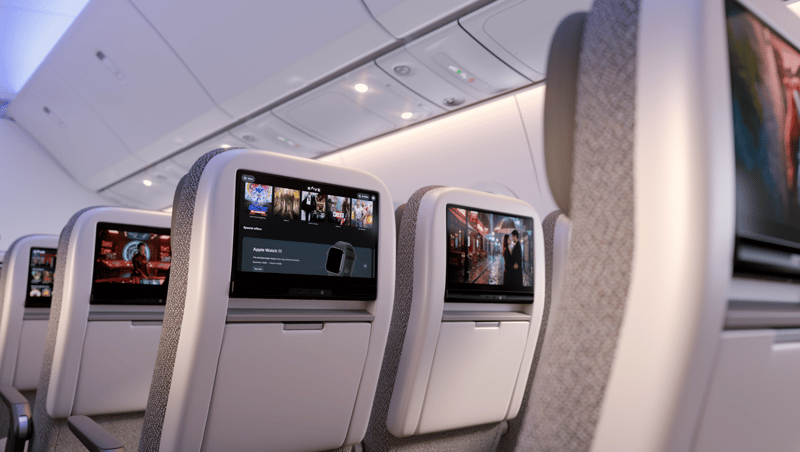
Airlines are racing to monetize the digital cabin, and they should be. Connectivity is not cheap, the ad inventory is genuinely valuable, and the platforms needed to activate it are finally mature.
The mechanics the industry is excited about right now, sponsored content, advertising, partner integrations, data-driven offers, look different from where the passenger is sitting. Each one is a withdrawal. The account being drawn from is the relationship the airline has spent decades building.
That account has a balance. It is hard to define, but finite nonetheless. In a connected cabin, it can drain faster than most airlines realize.
Deposits, withdrawals, and the balance that doesn't show up on the P&L until later
Think of the passenger relationship as a balance sheet running parallel to the commercial one. Every interaction onboard is either a deposit or a withdrawal.
Deposits are the moments that make a passenger feel the airline showed up for them: a free Wi-Fi session that just works, a personalized IFE experience that remembers where they left off, a loyalty notification that lands exactly when it is useful, a crew interaction that confirms the airline's brand promise.
Withdrawals ask the passenger to give something up: attention to an ad before their content plays, personal data to a partner, patience for a portal that loads slowly, time spent on a sponsored tile placed for the airline rather than for them.
Both are necessary and expected. A healthy commercial model includes withdrawals, and airlines should keep making them. The risk compounds when carriers start withdrawing before they can measure the balance, or tell a withdrawal a passenger barely notices from one that erodes the relationship.
Ad-free streaming did not last
Streaming subscriptions once meant no ads at all. The major platforms were sitting on something most airlines will recognize: high-value first-party data, captive attention, and a paying audience that genuinely cared about the experience.
Then the monetization conversation started. Ad tiers rolled out, and deposits and withdrawals fell out of balance quickly. The complaints are well documented: frequent ad interruptions, the same handful of ads repeated across a single binge, pre-rolls on services people already pay for, ad latency that breaks the moment a viewer settles in, ad-supported tiers that have grown into the majority of subscriptions while the experience got worse as inventory expanded.
The commercial side moved faster than the experience side, and the product got worse as a result. Frequency caps were not tight enough. Contextual signals were not rich enough. Targeting was not precise enough. Platforms compensated by serving more, more often, to more people, and the balance drained.
Airlines can choose a different path. The hardware is in place, the first-party data is valuable, and the ambition is right. What is missing is what streaming was missing too: the operational discipline to know, in real time, what a passenger is willing to spend.
The withdrawals airlines should actually worry about
Not every withdrawal carries equal weight. Five stand out as the most costly in a connected cabin.
A bad ad served at a premium moment
A business-class passenger who paid $7,000 for a lie-flat seat, watching an irrelevant pre-roll before their movie starts, experiences a bigger withdrawal than the same ad on a phone at home. Expectations are higher, and the brand context is more fragile.
Repetition
The fastest way to turn a tolerable ad load into an irritating one is to serve the same creative several times across a six-hour flight. It is an inventory and frequency-capping problem, but it lands on the passenger as an airline problem.
Mistimed personalization
A loyalty offer that arrives during a significant delay can read as the airline misjudging the room, even when the targeting behind it was technically correct.
Friction in the things passengers came for
When a monetization mechanism, a sponsored Wi-Fi portal, a sign-in flow tied to an offer, a partner integration with an extra step, slows the core product down, the passenger starts associating the airline's commercial activity with its overall competence.
Data uses that surface unexpectedly
Most passengers accept that a brand knows them. Few enjoy being surprised by how much. The moment personalization makes someone wonder what else the airline knows, the balance moves, whether or not anything was actually misused.
The deposits that earn the right to make withdrawals
Airlines also hold an unusually rich set of deposit mechanisms, most of them underused.
Competence is one. When connectivity works, when the IFE responds, when a transaction processes correctly the first time, when the app, the seatback, and the airport experience all agree on a passenger's status, each of those moments is a deposit. They rarely feel like a brand moment on their own, but they accumulate.
Personalization that saves the passenger something is another. Reaktor works with airline loyalty teams to make program value easier for members to find and use, and the result is typically a meaningful lift across reward bookings, spend, and engagement, all from making discovery easier.
Personalization that helps a passenger find what they already had is a deposit. Personalization that pushes them toward what the airline wants to sell is a withdrawal. Same technology, opposite direction on the balance sheet.
Earned context is the third, and the highest-yield deposit available: a relevant offer, served once, at a moment that makes sense, to a passenger whose data actually supports it. An airline running a media network on verified passenger identities and real engagement signals is making a bet that earned context can become a repeatable deposit. It can, but only at a level of data and ad-serving sophistication most airlines are not yet operating at.
A brand and infrastructure problem
This is more than a brand problem. Solving it takes more than a tasteful ad policy.
Knowing the balance, in any operationally useful sense, requires infrastructure most airlines don't yet have in the cabin: a unified passenger view connecting loyalty, booking, IFE engagement, IFC engagement, app behavior, and post-travel signals into one coherent picture.
Real-time decisioning that can suppress an ad, swap creative, or change a recommendation based on what is actually happening in this flight, in this cabin, for this passenger, right now. Without it, frequency caps and contextual rules are not grounded in the passenger's reality.
Clean rooms and partner data architecture let an airline prove value to a brand without exposing raw passenger records. Without that architecture, the commercial relationship becomes harder to govern.
A cabin-aware design treats the seatback as an intermittent-connectivity environment carrying the highest-value inventory on the network, rather than as a smaller version of the open web. A monetization layer that assumes the cabin is always online is incomplete.
These are the same infrastructure capabilities that make an airline's open and closed monetization paths work in the first place. They are also, not coincidentally, the capabilities that let an airline track its passenger balance with precision.
The work ahead
The airlines that get this right over the next few years will know which segments are net depositors and which are net withdrawers. They will know which moments in a flight have the lowest tolerance for monetization and which have the highest. They will know which partners run clean and which drain the account, and they will have the data and design infrastructure to act on all of it before passengers say so in a survey or a seat map.
Reaktor has spent more than a decade helping airlines build the digital experiences passengers actually feel, alongside the data infrastructure that makes those experiences commercially viable. As the cabin carries more commercial weight in the years ahead, the airlines that pull ahead will be the ones that make every withdrawal earn its place, and treat every well-engineered deposit as the asset it is.