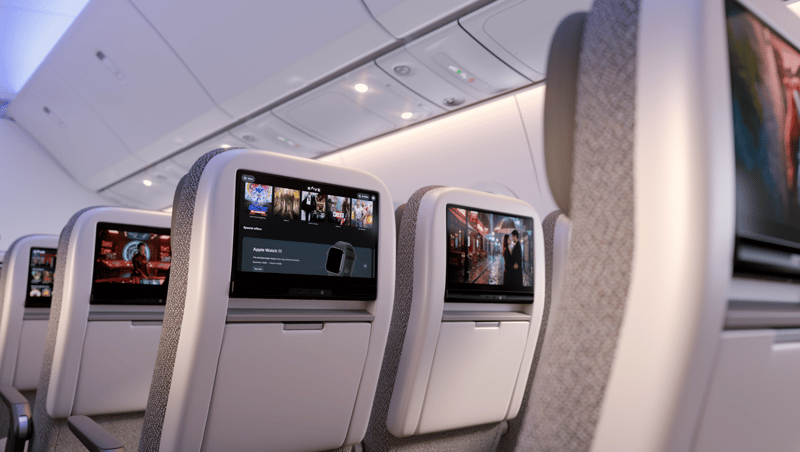

When Delta launched free Wi-Fi tied to SkyMiles membership in 2023, it moved the industry. JetBlue pioneered this, but Delta doing it at their scale, across a mainline fleet, changed the conversation. Now, with new entrant LEO providers making fast, free connectivity feel more viable for more carriers, free Wi-Fi is quickly becoming a baseline expectation. The tricky question that I’m being asked a lot is: “how do we pay for this?”
Two bets on the same opportunity
I’m seeing two distinct approaches take shape.
United launched Kinective Media last year as the first dedicated airline media network. Most of their stage time at this year’s APEX Tech was focused on the bet that the seatback screen and mobile app, backed by MileagePlus first-party data, can function as a legitimate and scaled advertising channel. Their pitch to brands is straightforward: 174 million passengers a year, verified identities, hours of uninterrupted attention, and cross-category behavioral data that most media networks can only approximate through third-party sources.
Delta has taken a different path. They've built a closed partner ecosystem where the value exchange is integration depth and loyalty enrichment. Delta Sync has enrolled over 3.5 million new SkyMiles members who previously boarded as strangers to the airline.
Both approaches are promising. Open marketplace advertising generates direct revenue but could risk the passenger experience or the brand. Delta's own CMO flagged the danger of overdoing ad load when they launched their first partner integrations. The curated model protects the brand but puts pressure on Delta to prove value to partners without focusing only on impression counts.
Both paths lead to the same infrastructure problem
What I haven’t seen talked about enough is that whichever approach you take to offset connectivity costs will create data infrastructure problems before they're revenue problems.
Kinective's ability to serve a relevant offer to a Macy's customer mid-flight depends on MileagePlus data being clean, unified, fast enough to be useful in real time, and structured in a way that can be shared with brand partners without exposing raw passenger records. That last part matters more than it might seem. Airlines are sitting on extraordinarily sensitive first-party data. The regulatory and reputational stakes around how that data gets shared are high. The DOT launched a review of airline data privacy practices shortly after Kinective launched, and it won't be the last time regulators pay attention to this space.
Delta faces the same dynamic. Their ability to walk into a room with a partner and justify the terms of a partnership depends on being able to show what SkyMiles members actually did on the IFE, on the IFC portal, before and after the flight, in a way that holds up to scrutiny, and in a way that the partner’s own data team can validate without Delta handing over its entire customer database.
Neither of those things happens automatically because you have interesting data. Airline data ecosystems are sprawling by nature. Loyalty platforms, reservation systems, IFE, IFC portals, mobile apps, and post-travel channels are typically spread across multiple vendors and legacy architectures that were never designed to talk to each other. Getting all of it into a single coherent picture of a passenger, and one that's commercially useful, partner-safe, and compliant is hard and complex work.
The media industry already lived through this
Airlines are at an earlier version of a moment the broader media industry has already been navigating. When traditional TV and entertainment companies tried to bring modern audience precision to advertising, the targeting logic existed and the data existed. What didn't exist was infrastructure reliable enough to support it. This infrastructure looks like unified pipelines, active monitoring, real-time activation, and clean rooms that let partners collaborate on audience data without either side exposing raw user records.
Building that took years and significant engineering investment. The companies that got there first had a durable advantage, not because their content was better but because they could prove value to advertisers in ways their competitors couldn't, and because they could do it in a way that held up under privacy scrutiny.
Reaktor worked through exactly this problem with Paramount's Advanced Advertising organization. The challenge was bringing modern audience targeting to traditional linear TV advertising at the scale of one of the world's largest entertainment companies. Paramount's advertisers were buying audiences: specific segments that had to be assembled, validated, and delivered across multiple platforms simultaneously.
Before the rebuild, different systems owned different pieces of the picture. Errors were hard to trace, and the consequences were massive. Bad data meant broken budgets, unreliable reporting, and damaged advertiser relationships. Switching data pipelines, a routine requirement when two years of historical data are needed to power predictive targeting, took two weeks. A mistake could mean two more weeks to re-run everything.
We re-platformed the entire data architecture onto Snowflake, built a data lake to standardize and validate inputs across sources, optimized the ETL pipelines, and implemented monitoring that surfaced errors immediately rather than letting them cascade. Pipeline switches that once took two weeks now take a single day, with zero system downtime even during active switches.
The underlying problem of a sprawling data ecosystem, fragmented ownership, the cost of errors in an advertiser-facing product, the need for speed and reliability at enterprise scale is the same problem airlines are beginning to confront now.
What the foundation actually needs to look like
For any airline data strategy to deliver on its promise, whether that's an open media network or a closed partner model, a few things have to be true at the infrastructure level.
Audience data needs to be unified. Loyalty, booking, and inflight engagement data scattered across systems produces stale segments and unreliable reporting, which no brand partner will tolerate for long. Pipelines need to perform in real time because a two-week processing cycle isn't competitive when partners expect fast activation and measurement. Data quality requires active monitoring because a small error in an audience segment can damage a campaign and erode a relationship that took years to build.
And clean rooms have become the expected mechanism for partner data collaboration. Rather than sharing raw passenger data with a brand partner, clean rooms let airlines and brands find audience overlap, measure campaign performance, and validate partnership value without either side seeing the other's underlying records. For airlines operating under DOT scrutiny and managing relationships with financial services partners like Amex who carry their own compliance obligations, this is the price of entry for serious partner conversations.
But there is a layer beneath all of this that the media world didn’t have to contend with: the cabin itself. The seatback IFE environment does not behave like the web. Aircraft lose connectivity. Long-haul wide-bodies can go dark for hours at a stretch, and on any given day, a meaningful share of the fleet may not be equipped with LEO connectivity. For airlines this isn’t a niche edge case, it’s the operational reality of the highest-value inventory on the network, and any credible media platform architecture has to be designed around it from day one.
These are the baseline for a functioning data product. But they require genuine engineering investment, and they require a team who understands both the data layer and the aviation environment it sits inside.
The data layer is where airline media strategies succeed or stall
We've built the infrastructure that makes passenger data commercially useful, partner-safe, and compliant. Talk to our team about what that looks like for your operation.