
Three days in Hamburg, and across nearly every airline conversation we had it seems the industry is racing towards making the digital experiences they’ve been promising a reality. Better screens. Better connectivity. Better experiences across every cabin class. The baseline is rising, and as it rises, the old ways of standing out are becoming passenger expectations.
What does differentiate, and what many of the conversations kept coming back to, is whether an airline can use the digital layer of the cabin to actually bring its brand to the passenger. A coherent, recognizable experience that feels like the airline across every touchpoint (human, physical, and digital), and gets better over time because the platform powering it was built to do so. That's the work the next few years are going to be about. Here's what AIX 2026 said about how it's going to get done.
Connectivity isn’t the full story
New entrant (if we can still say that) LEO providers came up in nearly every conversation we had this week, but rarely as the point. Airlines are past the "do we need fast Wi-Fi" question and have moved on to the harder, and in my opinion more interesting one: what should we do with it? The answer most carriers are coming to is some version of a unified, personalized, digital platform onboard. Not a portal. Not an IFE system with a Wi-Fi login tacked on. A real product that spans entertainment, retail, loyalty, operations, and passenger comms, and that treats the flight as a continuation of the digital relationship rather than a gap in it.
The airlines that want to lead in 2027 and beyond are starting to treat connectivity as product infrastructure. I wrote a while back about the two paths airlines are taking to monetize free Wi-Fi, one open (media networks) and one closed (curated partner ecosystems), and what was true then is even more true now: both paths only work if the data layers underneath them are actually built to support them.
The vendor map is getting blurrier
Something we heard from both airlines and vendors alike is that it’s becoming hard to cleanly explain who does what. Traditional content service providers are moving into platform and tech work. Tech and middleware vendors are building productized offerings that look a lot like what CSPs used to sell. Hardware vendors are building software ecosystems. Almost every category at the show has expanded its surface area, and a lot of the booths we walked past were selling something meaningfully different from what they were two years ago.
There's a straightforward reason for it. As the underlying technology matures, technical capabilities are feeling less differentiated for companies that offer off-the-shelf or productized software solutions. Cloud-native streaming is easier than it used to be. Bandwidth is easier to deliver. Simple portals are easier to build. When the hard technical moats soften, every player in the ecosystem starts looking for where the next defensible position is, and a lot of them are ending up in each other's lanes. For airlines trying to procure against this, it's genuinely confusing. The same capability shows up on three different booths with three different framings, and the category labels that used to tell you what to expect from a vendor don't tell you much anymore.
Now the challenge for airlines isn't just to find partners to design and develop the experiences that matter to passengers, but also to help them truly own the underlying technology and its capabilities. Experiences that are measurably better for the people on the aircraft, including the crew, and measurably better for the business running it.
IFE platforms are opening up
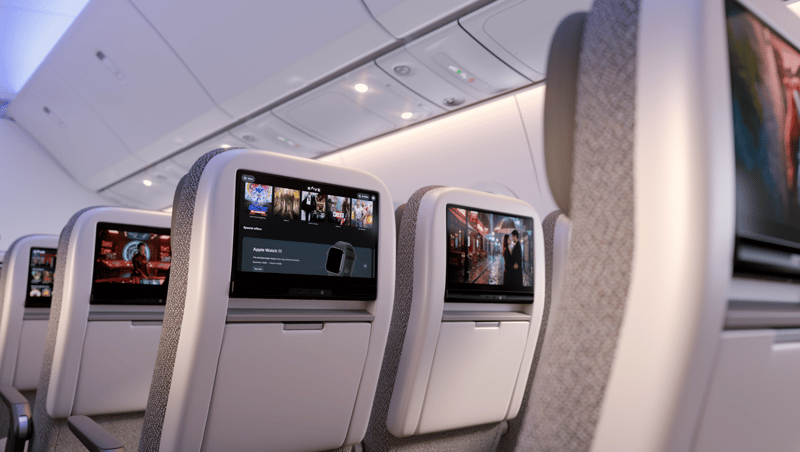
The big shift on the IFE side of the floor was RAVE Aerospace using AIX to introduce their new platform, positioned as a move from a closed system to an open platform architecture that lets third parties build on top. We were proud to be part of that story. RAVE showed Harmony, a next-generation GUI demo built jointly by our two teams on the RAVE Open Platform, as a proof point that partners like Reaktor can design and develop interface experiences within the RAVE ecosystem.
This sends an exciting signal. Historically, screen vendors strongly encouraged a setup where the software and the hardware shipped together, and airlines who wanted to differentiate the passenger-facing layer had to either accept what the vendor offered or run a custom program with heavy integration overhead. Reaktor became known for helping airlines that wanted to offer award-winning experiences navigate and deliver these projects, but it should never have been this hard. Open platforms should not only let, but encourage airlines to pick a hardware partner and a digital partner separately. Most importantly, open platforms let good ideas move faster because airlines don't have to renegotiate a vendor relationship to get something built. RAVE is the most public example at this show but my bet is they won’t be the last.
The personalization gap
Every vendor at the show talked about personalization, but most of them meant different things. A lot of what is getting sold as personalization is either too shallow to be useful or too aggressive to be comfortable. Airlines will get real value from personalization by learning how to balance what will make the passenger experience better, while also delivering business value. This will require airline data platforms to actually know who their passenger is across channels, which most still don't, because it is hard.
We've written before that most airline loyalty programs have an experience problem, and that the gap between the value an airline has built and the member's ability to understand and use it is where the real damage happens. Personalization, done well, is one of the most direct ways to close that gap. Done poorly, it widens it.
Wrapping it up
If the baseline is premium, and the hardware and service layer is increasingly comparable across carriers, the airlines that pull ahead are going to be the ones whose digital services feel just as unmistakably theirs as the services their crew offers. Coherent end to end. Recognizable across channels. Capable of improving in a modern, iterative way, not on 5 year cycles.
This operating model requires airlines to think of their digital product the way consumer companies think of theirs, and to pick partners who can help them think and ship at that cadence. The good news is that the capability is there. The platforms are opening up, the connectivity is real, and the passenger is more than ready. The hard part, as always, is organizational. AIX 2026 was a clear signal that the airlines willing to do that organizational work are going to break away, and the ones that wait will be left explaining why their cabin looks like everyone else's.
We're looking forward to being part of that work. Thanks to RAVE and the broader ecosystem in Hamburg, and to the airlines and partners who spent time with us this week.
The cabin is where airline brands are won or lost
We've spent over a decade helping airlines turn the digital layer of the cabin into something passengers actually feel. Talk to our team about what that looks like for your fleet.