
Most industrial leaders we talk to have spent years doing the right things. They've invested in data infrastructure, governance, and AI tool licenses for personnel. The technical foundations are largely in place. And yet the returns haven't materialized the way the business cases promised.
The technology is fine. The question is what it's actually being asked to do.
Part of the answer is a distinction that most organizations skip. Data is what gets collected. Information is what gets organized into a meaningful picture – a service history, a pipeline view, a customer timeline. Knowledge is what emerges when those patterns are understood in the context of how the business actually works: its customers, its operating model, its market realities, and the decisions it has made over time. Knowledge is what allows people, and eventually agents, to understand what matters, what is likely to happen next, and what action is most likely to lead to a better outcome. Most AI investments stop at data and information. That's why they disappoint.
AI gets deployed into organizations that are already under pressure to produce more: faster quotes, faster reports, faster decisions. The tool arrives and gets pointed at efficiency. Teams move faster through fragmented work instead of improving how the work fits together. Six months later, leadership is asking why the AI investment isn't showing up on the bottom line.
This is a pattern we see repeatedly across industrial organizations. Knowledge lives inside the people, and AI has no way of reaching it. And until organizations close that gap, they will keep getting assistants when they could be building something far more valuable.
Knowledge lives in people, and it keeps disappearing
Here's a concrete version of the problem. Across multiple sales teams, similar complex opportunities recur: teams spend weeks building context around customer environments, constraints, and the reasoning behind prior proposals, yet much of that knowledge disappears after the deal is won or lost. Months or years later, another team encounters a nearly identical case and starts from scratch.
Capturing lessons from past wins and losses would help teams identify solution patterns that improve win rates and profitability, while also revealing where the current product portfolio is structurally weak. In some segments or industries, the pattern may be that deals are rarely winnable with today’s offering, which becomes a product strategy signal: invest in new capabilities or a new product range rather than continuing to optimize sales execution alone.
The organization has a memory problem.
The same dynamic plays out in after-sales support, in product development, and in strategic planning. The collective logic behind decisions, the constraints that shaped them, the learning from what didn't work: all of it flows back into the noise of daily work. The organization keeps paying the cost of rediscovering what it already knew. And the people who hold that knowledge keep getting pulled into reconstructing context instead of applying judgment.
Agents can do more than assist, but only if you build the foundations now
There's a lot of enthusiasm right now about AI agents: systems that can act with some autonomy, reason across information, and handle complex multi-step work. The ambition is reasonable. But most organizations are nowhere near ready to use agents that way, and the reason is straightforward.
Agents need context to act well. They need to understand how your business works, how situations are typically handled, what constraints matter, and what good judgment looks like in your specific domain. Right now, most of that knowledge lives exclusively in people's heads. It surfaces in conversations, in the reasoning behind a decision that never gets written down, in the workaround a team has used for three years that nobody has ever formalized.
An agent built on top of that kind of organization becomes a hardworking assistant that doesn't understand what it's doing. And at scale, that creates waste faster than it creates value.
That's the proof of concept for what organizational memory can do. Now consider what becomes possible when structured knowledge is not just powering an assistant, but enabling an agent to synthesize signals across the organization and beyond – from frontline sales activity, installed base data, maintenance and spare parts patterns, and company signals from public sources such as investment announcements, expansion plans, sustainability commitments, acquisitions, or financial disclosures. By connecting these inputs, the agent could recognize when a modernization need is becoming likely, flag the opportunity before it enters the pipeline, and prompt the team to investigate and engage the customer proactively.The foundation is the same, but the capability is a different order of magnitude.
Making knowledge explicit is the hard part
Building organizational memory is hard work, and the technology is the smallest part of it.
The real work is making the logic behind decisions explicit. Teams need to surface how they interpret situations, what constraints guide their choices, and what they've learned from what went wrong. In practice, that means changing how work happens, not adding a documentation step on top of it.
The capture has to happen as a byproduct of doing the work: when a complex decision gets made, the reasoning behind it gets structured alongside the outcome; when something goes wrong, the learning gets captured in a form that can actually inform the next call, not just a retrospective nobody reads. That work runs through culture, incentives, and operating practices, well beyond the tech stack.
The goal isn't to document knowledge for its own sake. It's to make it shareable and updatable at scale, across teams, functions, and over time, so that both people and agents can draw on it without having to reconstruct the context from scratch every time. That's the shift from knowledge that lives in individuals to knowledge that lives in the organization.
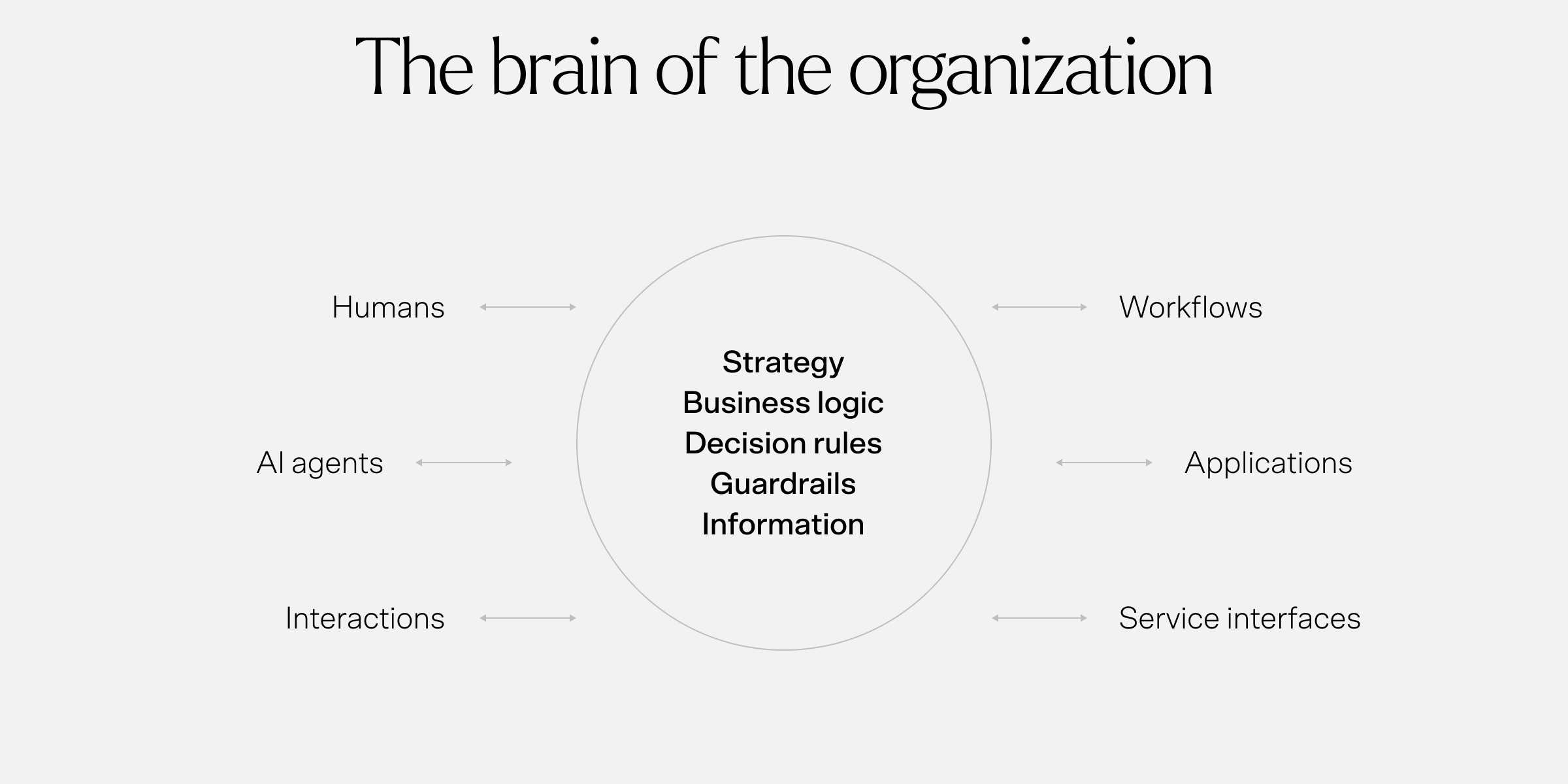
Most organizations don't do this because nothing has forced them to. Expertise stays locked inside individuals because that's how it has always worked, and because making it explicit feels like a risk. People reasonably ask what happens to their position when their knowledge becomes shared organizational property.
That concern deserves a direct answer. Consider a procurement team that has spent years developing a reliable instinct for which supplier relationships carry hidden risk: payment terms that look fine on paper but historically cause delays, contract language that signals future disputes. That judgment exists, but only in two or three people. When they're pulled into other work, the organization loses access to it entirely. Making that reasoning explicit ( what signals they look for, what patterns they've learned to distrust) doesn't replace those experts. It gives their knowledge somewhere to live beyond their own calendars. Others can interact with it, challenge it, and add to it. The expertise gets stronger through that exchange, not thinner.
Where leaders need to start
The organizations that will get genuine value from agents aren't the ones deploying the most tools today. They're the ones building the capability to make human wisdom accessible, reusable, and connected across the business.
That work starts with a few deliberate choices.
Pick one value stream that genuinely matters to the business and figure out what shared organizational knowledge should look like there:
- What context do people currently rebuild from scratch?
- What judgment calls happen repeatedly without ever being captured?
- What would an agent need to understand to handle that work alongside a person, rather than just beneath one?
Challenge the incentives that keep knowledge siloed. If people are rewarded for individual delivery and local output, shared context won't get built. The operating model has to make it worth doing.
Lead visibly. Leaders who contribute their own reasoning to the emerging shared context, who make their own decision-making logic explicit, signal that this is how the organization works now. That signal matters more than any tool rollout.
The ambition of agents as genuine colleagues is achievable. But it requires doing the upstream work first: capturing the wisdom that currently lives only in people, building the practices that keep it alive, and connecting it across the organization so that agents and humans can finally work from the same understanding.
Organizations have wrestled with this for decades. The same mistakes recur, the same lessons get relearned, and the cost of having no institutional memory quietly compounds. The current transformation is the first moment where fixing that is genuinely within reach, and the organizations that treat it that way will build something that pays back far beyond the AI investment itself.