Service is the most powerful differentiator
Traditionally, the service process has only begun when a problem occurs. But this is now changing. Today, companies stay in touch with customers beyond fault situations – offering visibility into how equipment is performing, analysing usage data, and reaching out proactively.
Service excellence can be the most powerful differentiating factor for industrial and manufacturing companies. Our white paper explores seven stories on why simply repairing equipment is no longer enough and why the focus is now on selling performance. Download the white paper today.
What is service excellence?
Service excellence refers to the ability of an organization to proactively deliver what customers need, such as providing reliability, operational certainty, and peace of mind, while strengthening trust and creating long-term value for the organization and the customer.
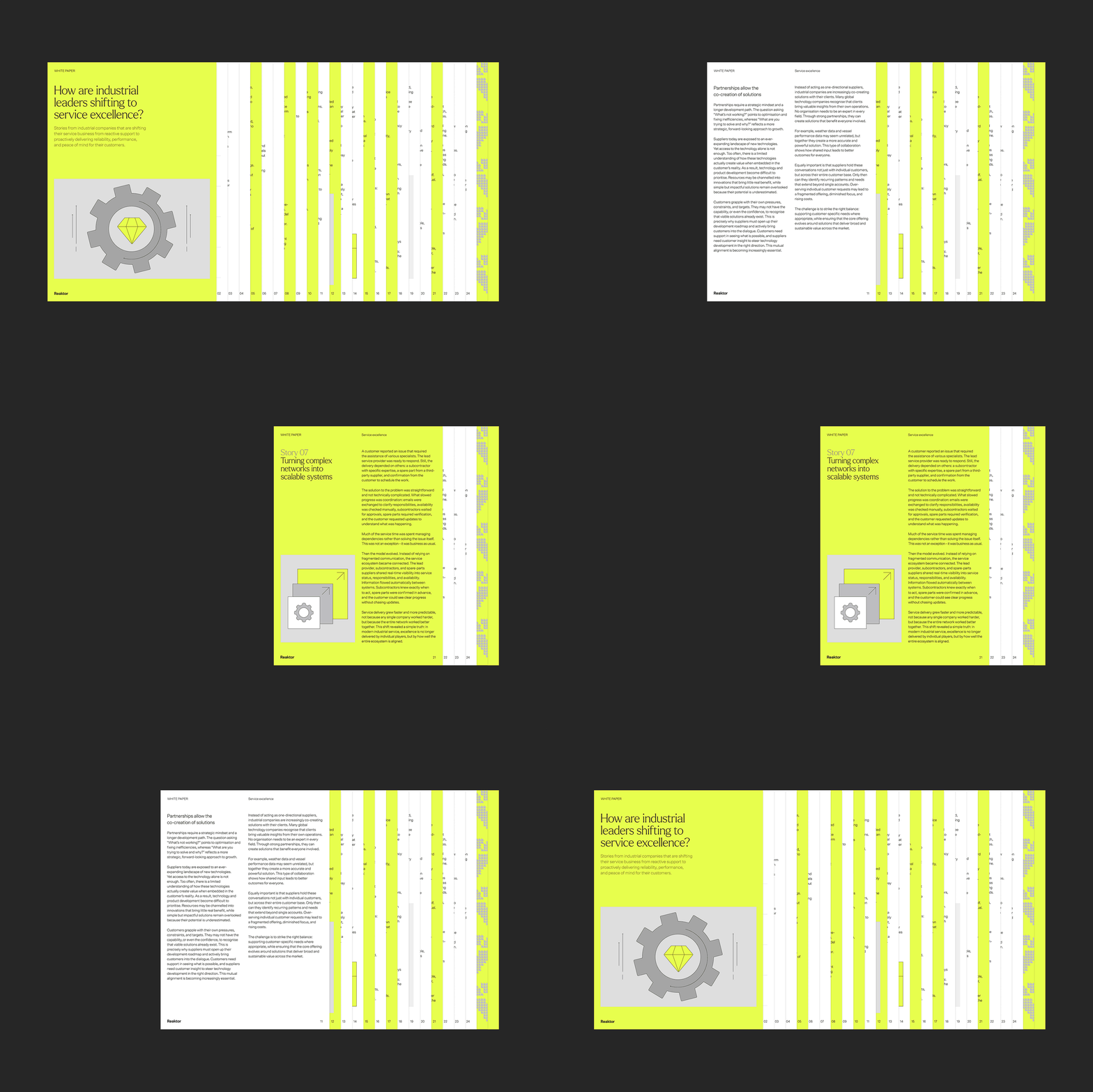
Seven stories on service excellence
This white paper explores seven stories that outline the value of service in the industrial setting.
true
Story 1: When experience makes all the difference
Today, success is increasingly shaped by customer experience: by how well a company listens, responds, and earns lasting trust. In the industrial sector, this has become a decisive differentiator. What sets companies apart is everything that surrounds the equipment: the clarity of information, the ease of getting help, the transparency of service, and the confidence that issues will be resolved quickly.
true
Story 2: Lessons on how transparency builds trust and loyalty
Transparency is more than a desirable feature; it’s a foundation for trust. With the EU Data Act, equipment manufacturers are now required to provide customers with access to their device data free of charge. However, data alone rarely creates value. Its real value emerges from the ability to interpret it, enrich it with other data sources, and translate individual data points into practical, actionable insights.
true
Story 3: The unexpected power of partnership
Partnerships require a strategic mindset and a longer development path. The question asking “What’s not working?” points to optimisation and fixing inefficiencies, whereas “What are you trying to solve and why?” reflects a more strategic, forward-looking approach to growth.
true
Story 4: How customer value is materialised into revenue growth
Value-based service starts from a simple principle: customers should gain more value than they pay for – and they should feel that value clearly in their daily operations. In industrial settings, this value often shows up as reduced downtime, smoother workflows, fewer surprises, and decisions that can be made with confidence rather than guesswork.
true
Story 5: The curious case of an old customer and missing information
Good documentation is not just an administrative task. It enables faster response times, more accurate decisions, and consistent service quality regardless of who happens to be working that day.
true
Story 6: The journey toward a customer-driven culture
In many industrial companies, internal processes, handovers, and decision structures can be just as slow or fragmented as the customer environments they aim to support. Improving service excellence, therefore, starts with improving how the organisation works from within. To shift toward a truly customer-centric mindset, the organisation has to rethink how it operates internally.
true
Story 7: Turning complex networks into scalable systems
An agent-to-agent supply chain communicator is something that we have been experimenting with here at Reaktor. We are testing how AI agents handle conversations and autonomous data transfers between companies that people have usually carried out manually or via tightly coupled integrations.
Get your copy now
Ready to get started?
Download the white paper