Summary
Information-seeking behavior is changing. Conversational AI is becoming a natural part of how people find out more about everything from personal shopping to health content. As AI becomes part of how people access health information, it's more important than ever that the answers they receive are grounded in verified, doctor-reviewed sources rather than unverified content.
That's why we partnered with Thuisarts, a trusted Dutch health information platform, so people can easily access reliable health information rather than relying on answers whose medical sources cannot be verified.
Project highlights
Always verified
The Thuisarts AI Assistant retrieves information that is always based on GP-verified guidelines.
Millions of potential users
Built for everyone in the Netherlands, Thuisarts’ AI Assistant can serve the entire population.
Accessible
The tool helps clarify the question and check the answer, making it easy to use for all digital literacy levels.
.png)
Looking for reliable health information?
Thuisarts is a leading Dutch health information website, with 80 million unique page views in 2025. It was launched in 2011 to meet the growing demand for reliable health information and improve health literacy in the Netherlands by translating GP guidelines into layman's terms. Today, it also provides accessible information about specialist medical and other health-related topics.
The information on Thuisarts’ website is written and verified by real doctors and is based on clinical guidelines used across the Netherlands. But while it holds a treasure trove of verified health information, it’s buried in static pages. With the advent of LLMs, the way content is created and consumed is changing, and as a result, the team at Thuisarts saw a strategic need to explore it.
As conversational systems reshape how knowledge is accessed, how can Thuisarts further its position as a leading health platform? Their team asked Reaktor to investigate the potential of using AI and LLMs to improve accessibility to health information.
Why better alternatives are needed
Reaktor developed a strategic plan for Thuisarts, identifying the opportunities and risks of generative AI in healthcare. The results showed that utilizing LLMs for health information carries inherent risks, but not adopting the technology does as well.
Making health information accessible in plain language is Thuisarts' core mission – and increasingly, what people expect from AI. That creates both an opportunity and a risk. As platforms like ChatGPT, Claude, and Gemini become part of everyday life, more people are turning to them for health information. The margin for error is high. LLMs base their answers on vast amounts of unverified data from across the internet, which can include misinformation or even disinformation that’s designed to deceive, manipulate, or harm the general public. This can have deep consequences for society, healthcare, and government organizations.
"I discovered ChatGPT about six months ago, and now I can find information in no time. It's so much more convenient. I hardly use Google anymore." – A Thuisarts test user
It became apparent during our research that Thuisarts was already losing users to this new way of consuming content. If Dutch residents rely on general-purpose AI tools for health information, they risk encountering inaccurate answers or answers that don’t fit in the Dutch healthcare system. Over time, this could erode trust in verified health sources and put unnecessary pressure on the healthcare system.
We recommended that Thuisarts start exploring better alternatives to commonly used general-purpose AI tools in order to avoid falling behind global players in the market for health information and, perhaps even more importantly, health misinformation.
A new way to find health content
During the research and development phase, three central insights emerged. Although Thuisarts offers extensive, high-quality health content, wayfinding proved genuinely hard: getting from a personal health situation to a concrete question, and from that question to the fitting article, took more effort than it should. Users also made clear what they wanted from AI: a thought partner that helps them make sense of their situation, while diagnosis stays with their doctor. And because Thuisarts' own content is the basis of users' trust in the platform, any solution would need to elevate that content rather than sit on top of it.
Research found that people wanted to cut through the noise and find information that felt relevant to what they were looking for. Among the concepts tested, the AI-assisted information guide proved most compelling in addressing this need and was consistently favored in user evaluations. The resulting solution, the Thuisarts AI Assistant, was conceived as a conversational tool to help Dutch residents find their way to reliable health information.
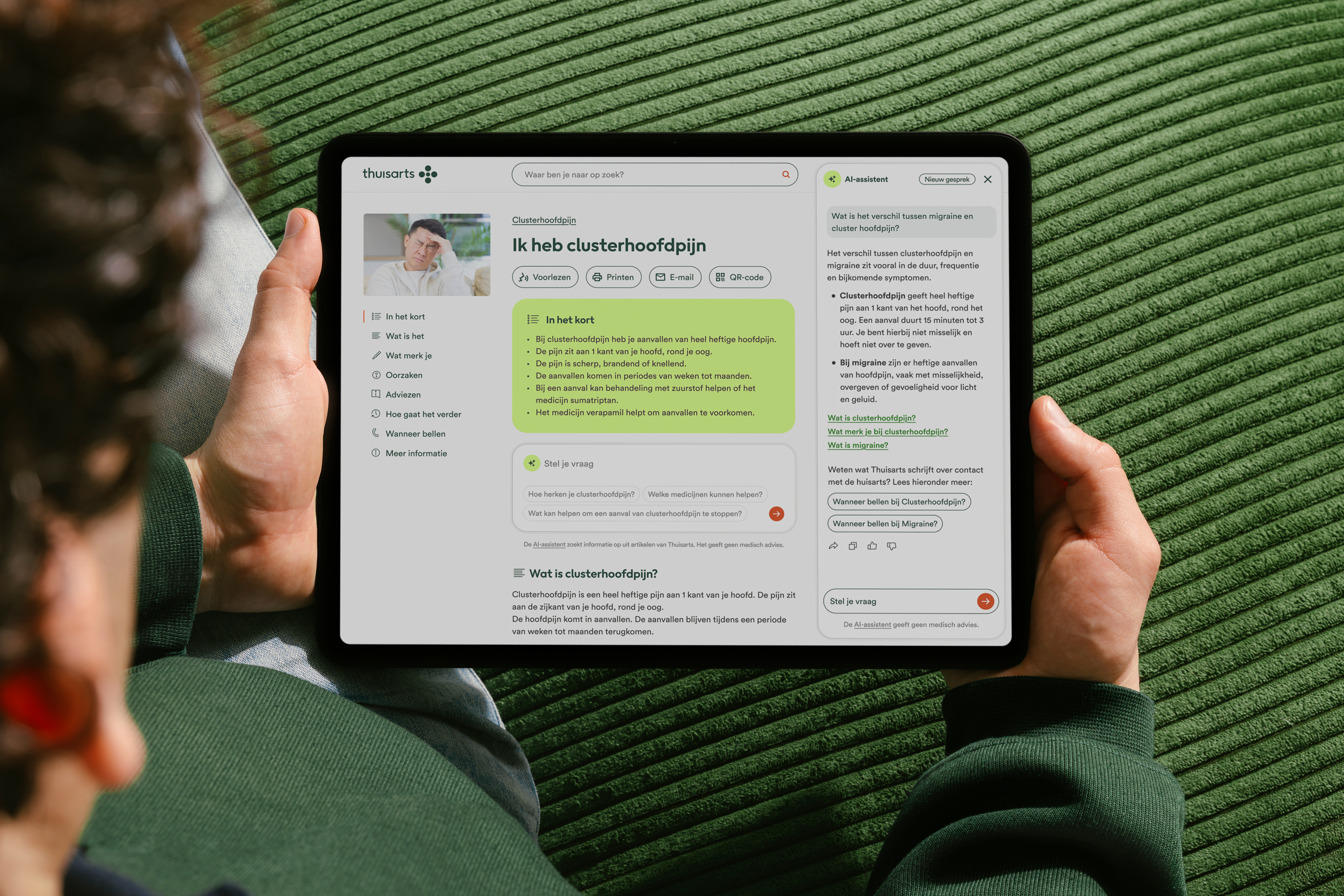
Importantly, the AI Assistant is not a medical device and does not provide medical advice or diagnoses. It is a smart search tool that finds reliable health information on Thuisarts and presents it in plain language: working to understand what the user is looking for, asking clarifying questions where needed, and navigating them to the right information. In essence, it thinks with you, not for you.
.png)
Reducing risk with guardrails
One of the major risks of LLM chatbots is their tendency to hallucinate, producing incorrect or fabricated information and presenting it as fact.
To ensure that every answer is grounded in trusted health information, we built the system with several safeguards. One of these is a Retrieval-Augmented Generation (RAG) setup, which retrieves relevant information exclusively from Thuisarts' up-to-date, doctor-validated content. Unlike LLMs that rely on static training data or web searches, this ensures responses are based on trusted sources and reflect the Dutch healthcare system, where medical guidelines and protocols may differ from those in other countries.
But retrieving the right information is only part of the solution. When a user's question is too broad or unclear, the system first asks follow-up questions to better understand their situation before generating an answer. Every response is then checked in real time against the original Thuisarts content to verify that it accurately reflects the source material.
For the user, this means every answer is based on Thuisarts' verified content and validated before it is shown. These safeguards reduce the risk of hallucinations and inaccurate interpretations, while ensuring that every response can be traced back to trusted medical guidance.
.png)
How we ensured meaningful adoption
Adoption rarely occurs spontaneously. It depends on context, timing, and perceived relevance. We did extensive user testing to explore how people might be meaningfully introduced to the tool. Early experiments, which included pop-ups and videos, yielded useful insights into user behavior, revealing a preference for unobtrusive, situational nudges over interruptive cues.
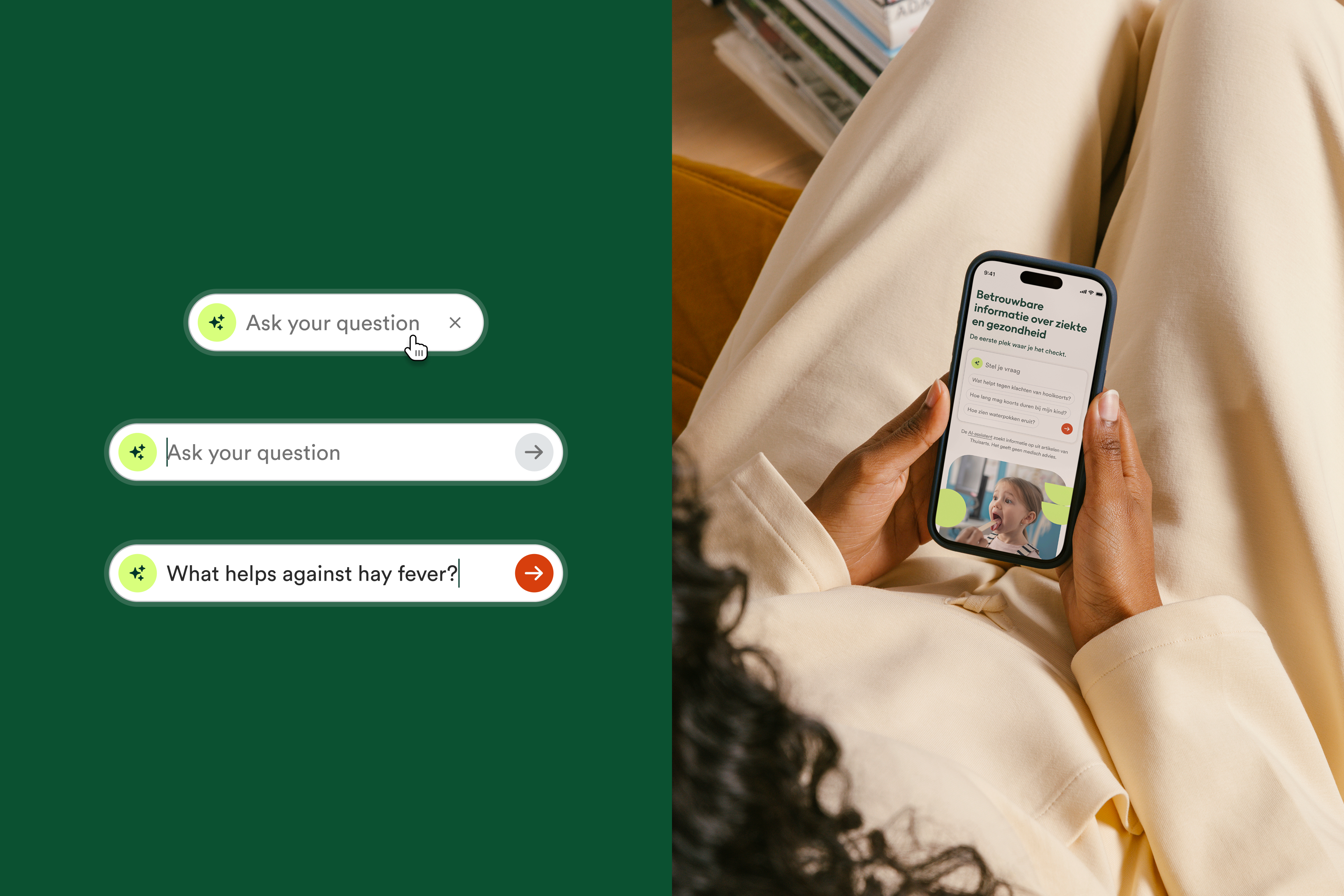
How might a chat tool be introduced in a way that feels intuitive, timely, and genuinely helpful? That was the big design question. To address it, we created a context-aware onboarding process with perfectly timed triggers to catch people at the exact moment they felt like asking a question.
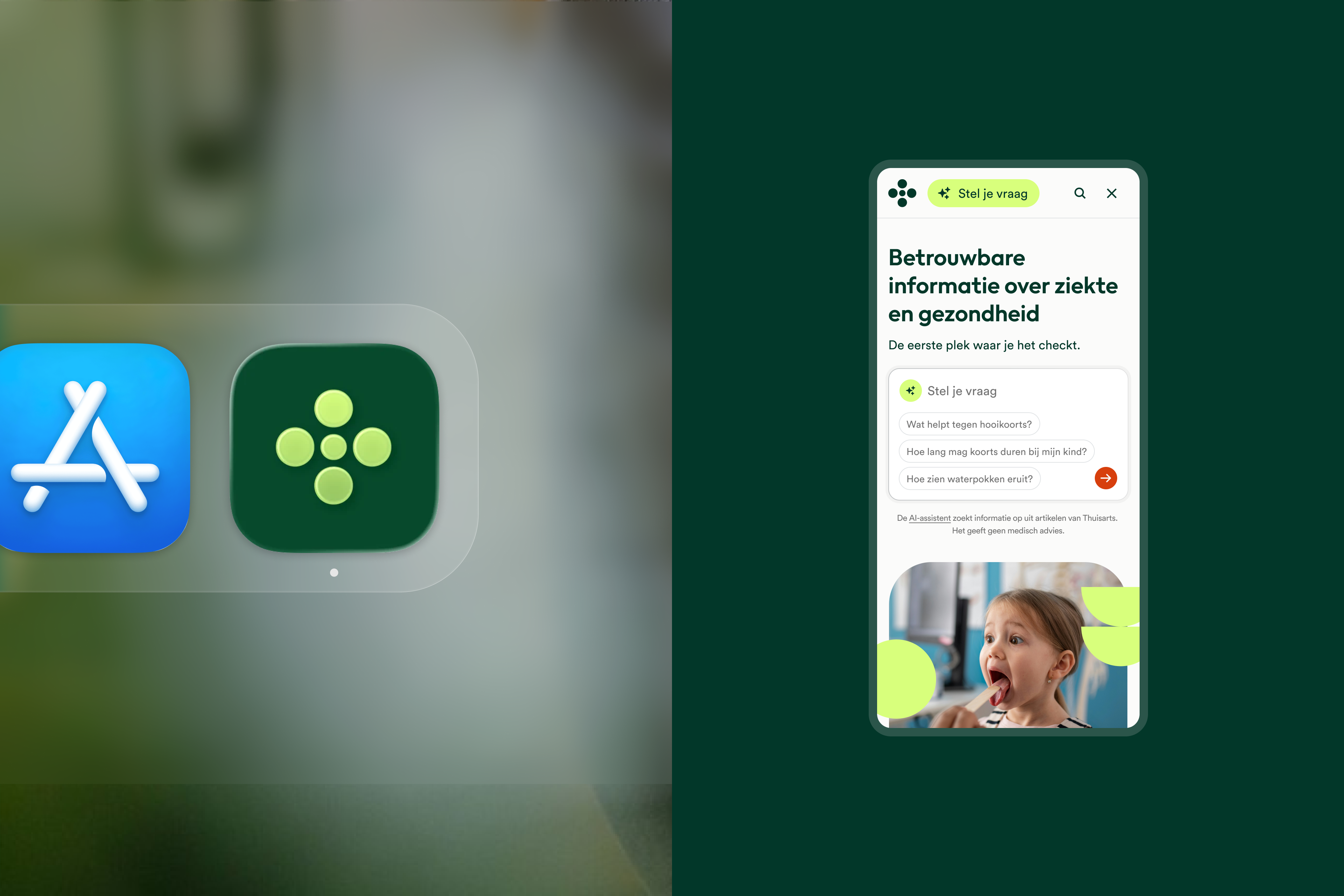
To do this, we examined the user journey in detail. At what point in the user journey is this tool most useful? Where do people look for search options? The solution involved placing sticky bars, widgets, and contextual suggestions directly within relevant content areas, such as articles, enabling users to ask questions without disrupting their browsing experience.
To make it even easier, we created “thought-starters”, which are short suggested questions that model effective queries. In doing so, the Thuisarts AI Assistant became not merely an add-on feature, but one that’s intuitively nested within the platform's existing experience.
The elements of conversation
Optimizing for a good conversation may sound simple, but it requires careful calibration. We constantly needed to validate through user tests to ensure information quality and an optimal user experience. For instance, with RAG, we needed to know whether there was enough information in Thuisarts' database to provide answers that made sense. We also needed a system that would know when it didn’t have enough information, so it could proactively ask the questions.
Small adjustments in tone, structure, or phrasing can lead to big changes in user perception. When responses were too long, they were often interpreted as vague, while particular word choices risked eliciting unnecessary anxiety.
From AI specialists to real GPs, Reaktor drew on a cross-functional team and EU legislation specialists to fine-tune the AI Assistant’s responses, improving clarity and relevance while balancing technical feasibility, user demand, and cost-effectiveness.
“I like that it asks follow-up questions. Not just like 'here's your answer, go figure it out.'”
User feedback
The results
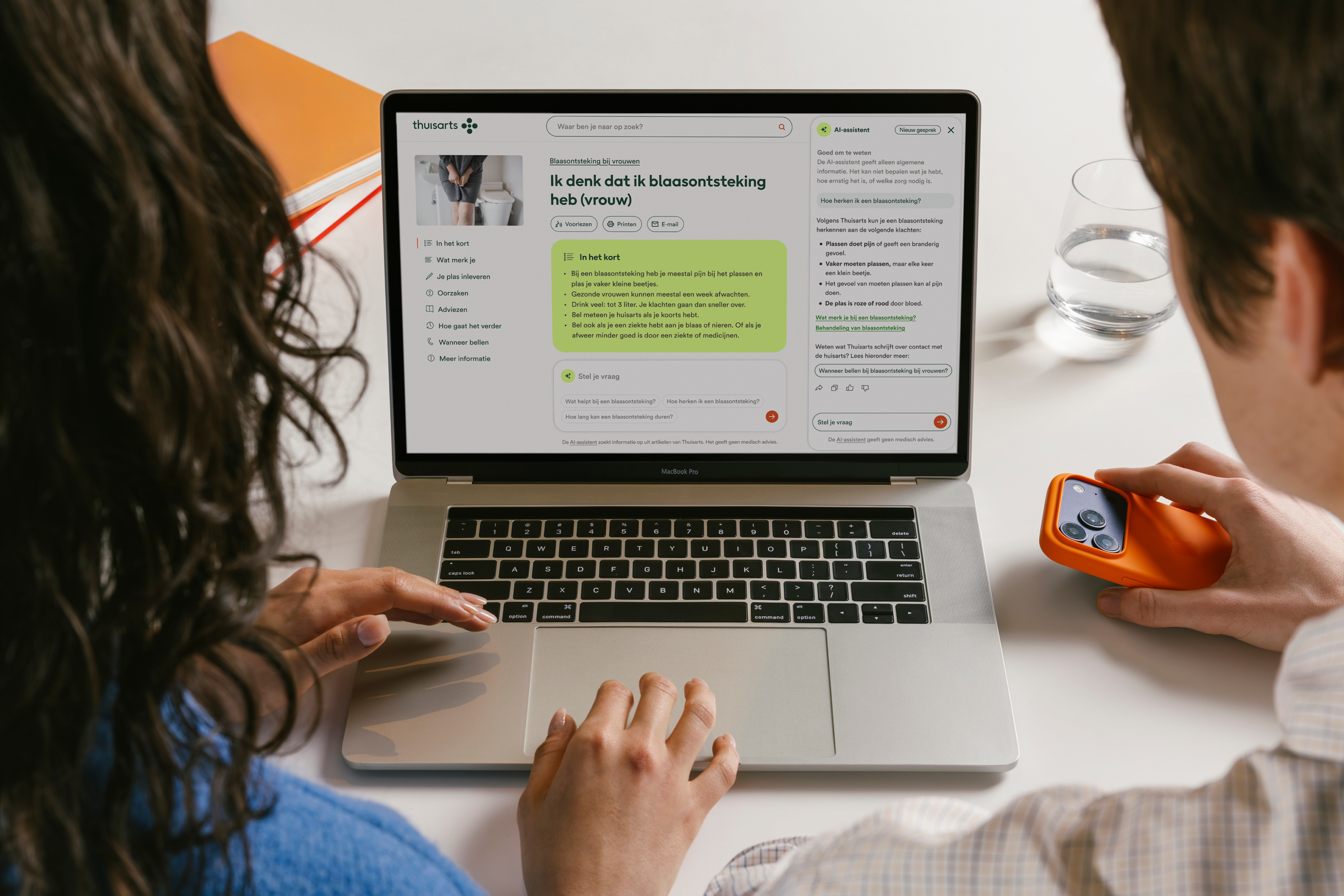
As general-purpose AI tools reshape how knowledge is accessed, Thuisarts has moved to meet users where they are, strategically reinforcing its position as a leader in health information.
Thuisarts’ AI Assistant was released with high expectations for its role in supporting its mission to make health information accessible in plain language. Unlike general-purpose AI tools, the system draws only from verified Thuisarts content, potentially reducing the exposure of the general public to misinformation or even disinformation. Now, people in the Netherlands can use the Thuisarts AI Assistant to quickly find what they are looking for.
It has been thrilling to work with pioneers in the health industry by bringing the latest advancements in generative AI to the sector in a reliable, trustworthy way. We are excited to continue working with Thuisarts to measure both the quality of the service and its contribution to the wider healthcare system. The insights will guide content and UX improvements, inform technical tuning, and provide evidence for the value it delivers.
Our contributions
→ Strategic planning and direction
→ Research and development
→ Product design
→ User testing
→ Evaluations and guardrails
→ Large Language Models (LLM)
→ Retrieval-Augmented Generation (RAG)
→ Other tools: Python, Micro front-end, Vector databases, React UI Library
Contact
Let's take the next step together!

Juuso Haaksivuori
Business Development Director, Reaktor Health