Summary
M-Files, a leading player in knowledge work automation, was looking to expand and build on its generative AI efforts. To do so, they partnered with Reaktor to develop a comprehensive generative AI product strategy. The new strategy sets the stage for a clear vision, an actionable roadmap, and a framework that supports the organization in making the right decisions fast when it comes to generative AI.
Project highlights
Aligned vision
A unified generative AI vision supported by five key focus areas for future development
A new framework
A prioritization framework that supports decision-making for generative AI development
Actionable roadmap
A strategic roadmap for both immediate and future work
Measuring impact
Measurable KPIs and value propositions for each strategic pillar
Background
M-Files offers a unique approach to document management. Instead of a folder system for hierarchically organizing documents, M-Files organizes information automatically and puts content in context. For some time now, the company has been exploring new product opportunities with generative AI. Having successfully released a few rounds of capabilities to their generative AI assistant Aino, M-Files was ready to go to the next level. To do so effectively, they needed to make sure they had a clearly defined shared goal and a plan of action.
This is where we came in. At Reaktor, we have long-standing expertise in designing, building, and shipping tangible AI applications. With this experience, we helped M-files navigate both the opportunities as well as the limitations of this emerging technology. Our goal was to craft a strategy that not only lays out a futuristic vision for the company’s roadmap, but that also makes sense in practice and helps translate complex ideas into tangible results.

Drafting a unified strategy
We kicked off the project with a discovery phase, starting with a workshop exploring the current state of M-Files’ generative AI efforts. We then interviewed 11 key stakeholders across management, product, and business teams. The interviews revealed just how much diversity existed when it came to ideas around implementing generative AI.
Following the interviews, we facilitated a future-oriented workshop to nail down the most impactful applications of GenAI at M-Files. These collaborative sessions allowed us to identify the various viewpoints and opportunities to create measurable value with GenAI.
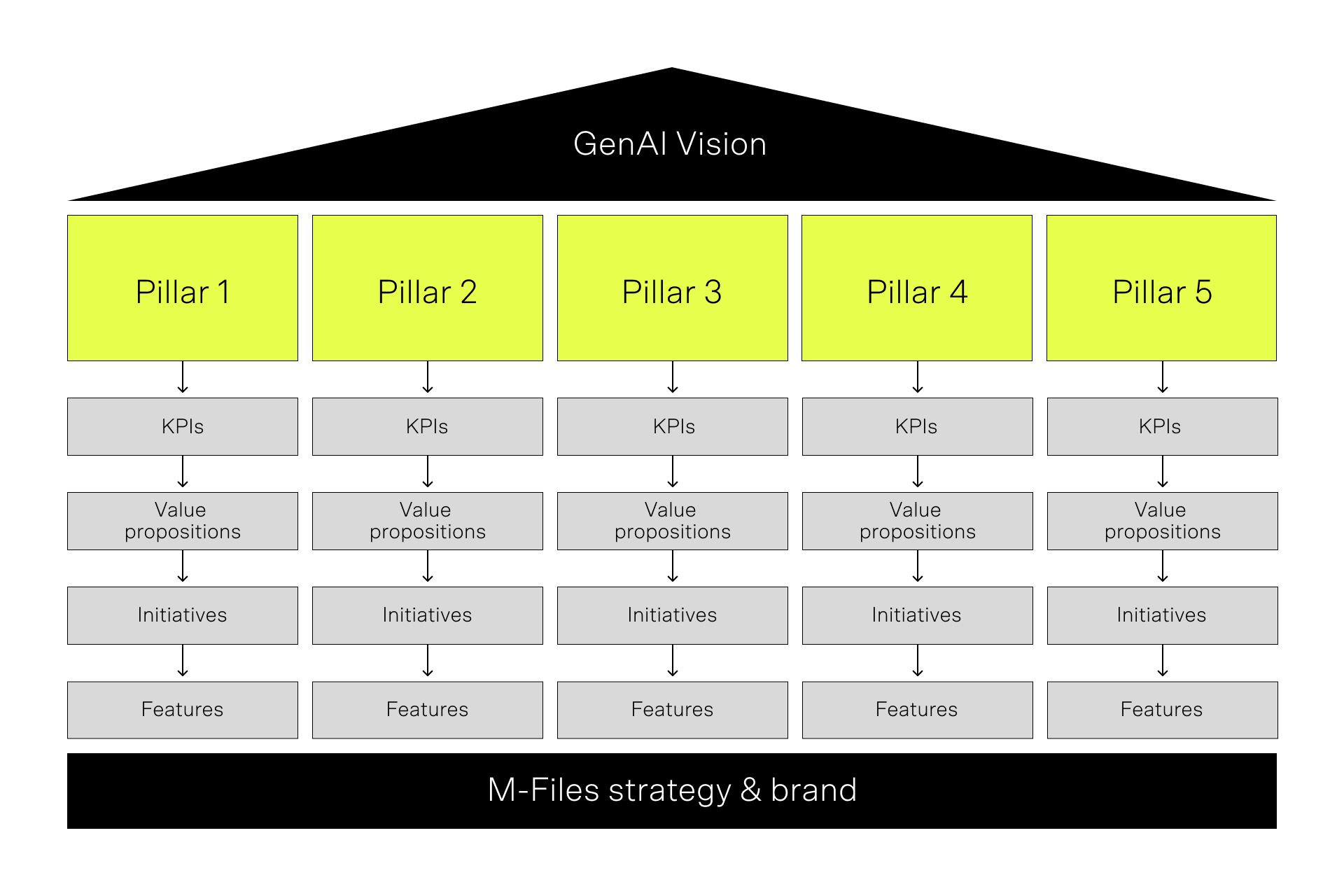
The outcome was a structured "strategy house" that included:
1. An overarching GenAI vision
2. Five strategic pillars representing key focus areas
3. Value propositions for end-users, customer companies, and M-Files
4. KPIs and measurable goals for each pillar
5. Specific initiatives and features aligned with each strategic pillar
A prioritization framework
With a clear strategy in place, we shifted focus to prioritizing the pillars and initiatives. We used a custom framework to assess the impact of each pillar, allowing M-Files to always focus their efforts on the most promising areas. Based on this prioritization exercise, we created a draft roadmap that visualized the implementation timeline.
The strategy and roadmap not only aligned the various teams within the company, but also provided a tool for ongoing decision-making with future work. With this strategy and framework in place, M-Files is now able to act faster and know where to best place their generative AI efforts. In this rapidly changing space, there is nothing more important than fast and accurate decisions together with hard-core execution.
"Collaboration with Reaktor was fluent and highly professional, yet they challenged us positively. The deliverables were immediately useful for our leadership team and shared with the entire staff. This gives us a good head-start in operationalizing the new GenAI strategy."
Antti Kujala
Vice President of Design and Product Management
Contact
Let’s take the next step together!

Hannele Ulvas
Business Director