White Paper

Modern Wi-Fi onboarding for inflight connectivity

Aaro Korhonen

April 23, 2026

Engineering guide to captive portals.


Why legacy captive portals are quietly failing, and how CAPPORT fixes it

If you're still running a legacy captive portal, it's quietly failing more passengers every release cycle. Browser vendors keep narrowing the conditions under which DNS- and DPI-based redirects work: as of 2026, 98.3% of web traffic runs over HTTPS, and that share keeps climbing. CAPPORT, the IETF's standards-based alternative, is now mainstream: roughly 90% of passenger devices are already CAPPORT-capable.

This guide breaks down why the legacy model is harder to maintain than it looks, and how CAPPORT delivers a cleaner path forward for airlines and passengers alike.

What is a captive portal?

A captive portal holds network access until a passenger authenticates or accepts terms. Traditionally treated as a gatekeeper, this guide argues for a different approach: keep the captive portal thin, and treat the inflight portal it leads to as the product. The faster passengers clear onboarding, the sooner the airline earns the engagement, loyalty sign-ups, and ancillary revenue the real portal experience is built for.

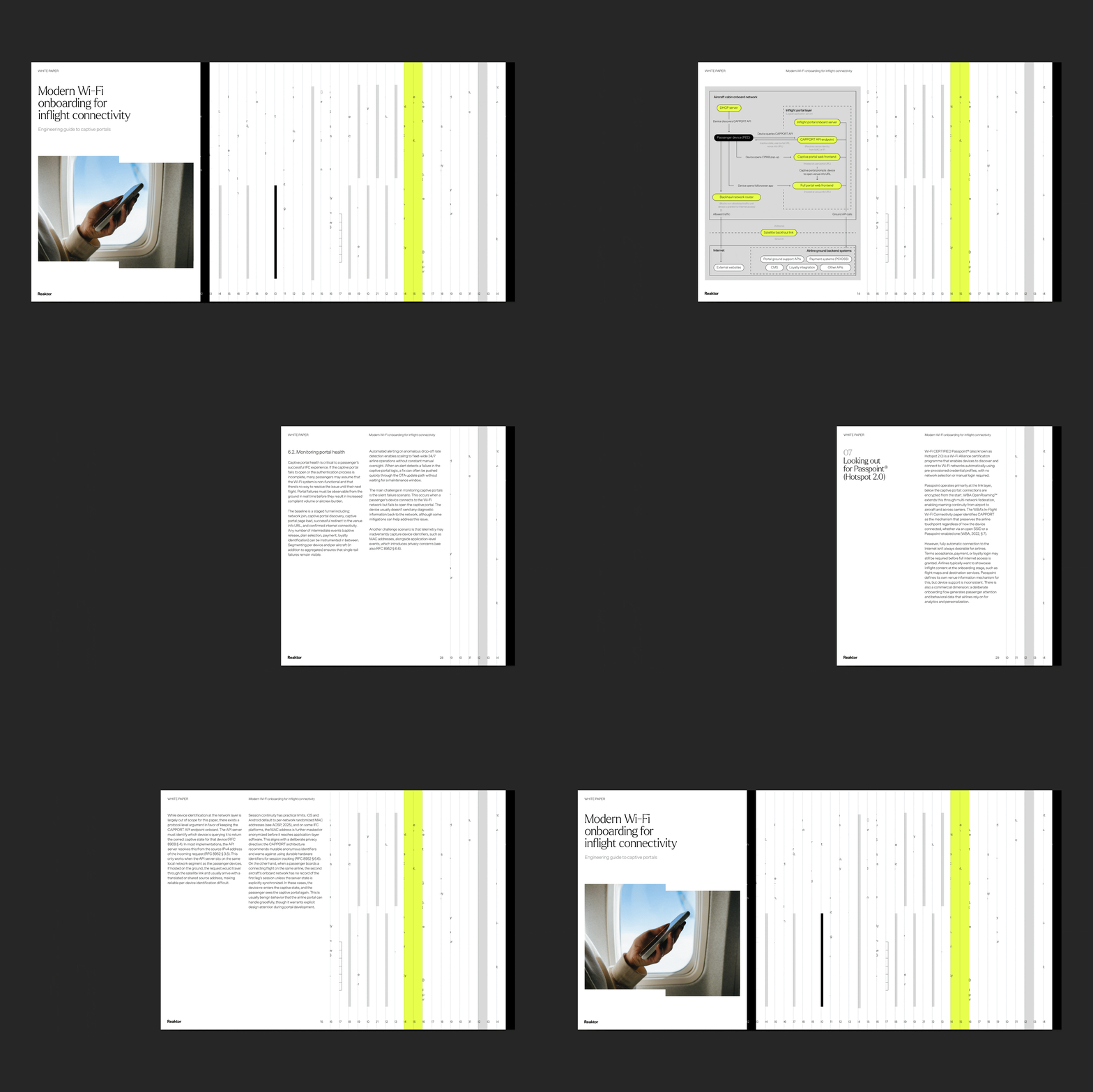
reaktor-aero-wp-modern-wifi-onboarding-2026

Building captive portals for the modern era


This guide examines the gap from network architecture and captive portal standards through to integration, device compatibility, and operational deployment.

true

Evolution of Wi-Fi onboarding

From legacy to modern captive portal. The way devices connect to inflight Wi-Fi has changed – but most portal implementations haven't kept up.

→ How did legacy captive portals work, and where do they fall short?
→ What does the shift to standards-based onboarding look like in practice?
→ How does CAPPORT redefine the handshake between network and device?


true

Meet the inflight connectivity stack

The captive portal sits inside a layered system of hardware, software, and stakeholders, each with its own architectural responsibilities.

→ Onboard vs. ground-hosted deployment: what's at stake?
→ Why does the CAPPORT API endpoint belong on the aircraft?
→ How session continuity works – and where it breaks down?


true

How different devices handle captive portals

Every major operating system handles captive portal detection differently. Building a portal that works reliably means understanding each platform on its own terms.

→ How does Apple's captive network assistant (CNA) interact with CAPPORT?
→ What makes Android behaviour harder to predict?
→ How do other platforms and edge cases factor into implementation?


true

Why less is more in captive portal design

The best captive portal is one that passengers barely notice. The goal is to guide passengers through it quickly.

→ Why treating the captive portal as a springboard beats building it as a destination?
→ How does the venue info URL create a stable, branded experience passengers can return to?
→ Why does a thin portal mean better data, better personalisation, and less to maintain?


Related content

Cabin monetization has a hidden cost: the passenger relationship's balance

Cabin monetization has a hidden cost: the passenger relationship's balance

  • Article
Reaktor and Alaska Airlines partner to deliver next-generation in-flight connectivity

Reaktor and Alaska Airlines partner to deliver next-generation in-flight connectivity

  • Announcement
What fashion, airlines, and grocery can learn from each other's apps

What fashion, airlines, and grocery can learn from each other's apps

  • Article
Reaktor takes top honor in Digital Leadership at Cathay Supplier Awards 2025

Reaktor takes top honor in Digital Leadership at Cathay Supplier Awards 2025

  • Announcement

Download engineering guide to captive portals