This is part of a series exploring what great mobile loyalty looks like across industries. We've built loyalty apps for fashion retailers, airlines, and grocery brands, and each vertical has taught us something different. This article covers grocery.
Grocery is the highest-frequency loyalty category in existence. A committed member might interact with a grocery program three or four times a week, every week, for years. No other retail category comes close to that kind of sustained, repeated contact. In theory, this makes grocery the easiest place to build genuine mobile loyalty. The opportunity to show up in a customer's life is constant.
In practice, most grocery loyalty apps have done remarkably little with that opportunity. Members use them because they save money, not because they add anything to the week. The brands changing that dynamic have understood something worth paying attention to: the grocery app that earns a place in the weekly routine builds a kind of loyalty that no competitor discount can touch. There's real opportunity in becoming that app: the one that reduces the mental load of planning, shopping, and cooking, making everyday food decisions easier. A supermarket that gets there builds a switching cost no competitor discount can match.
Frequency is an asset most programs waste
The regular rhythm of grocery shopping is the foundation everything else should be built on. A customer who shops three times a week is potentially opening the app three times a week. That's an extraordinary amount of contact time compared to fashion, where a brand might see a customer four times a year, or even aviation, where a frequent flyer might book a handful of trips annually.
But frequency only becomes an asset if the app gives customers a reason to open it beyond the checkout scan. Many grocery loyalty apps are still finding their footing here, centered mostly around the transaction moment: a barcode to scan, a list of offers, a points balance to check. There are lost opportunities if the relationship begins and ends at the till.
Instead, the apps that genuinely earn daily engagement are the ones that insert themselves into the decision that happens before and after the shop, not just during it.
What are we eating this week? What do we need to buy? How do I cook this dish so it comes out right? These are questions every household faces multiple times a week, and they're questions a grocery app is uniquely positioned to help with. The customer who plans their meals inside your app, builds their shopping list inside your app, and then completes the order through mobile has given you something far more valuable than a loyalty card scan. They've made you part of their routine.
From coupon dispenser to kitchen companion
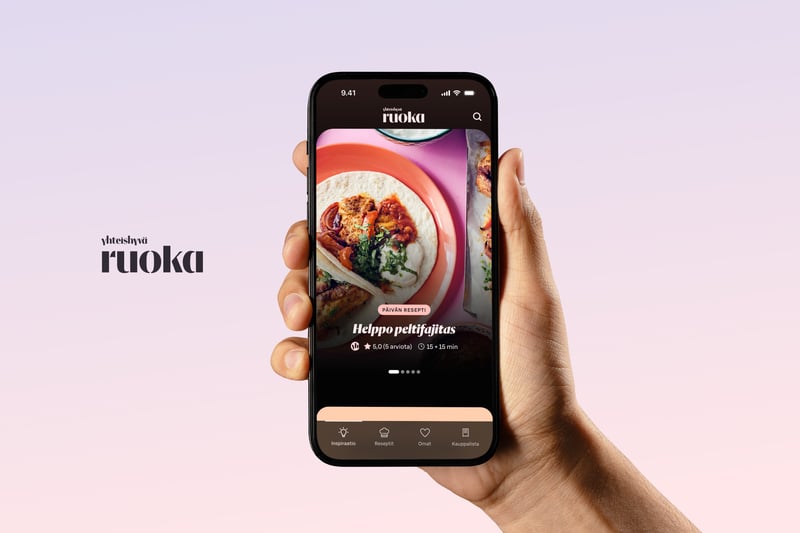
Building Yhteishyvä Ruoka for S Group, the brief was to build a service that supports the full food journey, from the first spark of inspiration on a Sunday afternoon to the moment dinner is on the table on Friday night.
The insight behind the app was straightforward but easy to miss: the pain in weekly food planning isn't finding recipes. The pain is the friction between inspiration and action. A customer finds a recipe they want to make, then has to separately figure out what they need to buy, then has to remember to buy it, then has to find it in the store, and finally, return to the recipe and cook the meal. Each step is a small moment of effort, and collectively they're enough to make meal planning feel like more trouble than it's worth.
Yhteishyvä Ruoka collapses that friction. A customer browses recipes that connect to seasonal ingredients and current trends, builds a meal plan for the week, and adds every ingredient directly to their shopping list in a single tap. The app maps those ingredients to real products available in S Group stores, accounts for portion sizes, and connects directly to the online grocery ordering service for customers who want home delivery. The step from recipe to cart is a continuation of the same flow, not a separate task.
What makes grocery mobile loyalty work
There are a few principles of great mobile loyalty apps that apply more broadly to grocery loyalty.
The first is that utility has to come before loyalty mechanics. A customer who finds genuine value in the app, who uses it to find inspiration, plan meals, and simplify their weekly shop, will return to it habitually. That habit is more durable than any points multiplier. Loyalty follows utility; it rarely precedes it.
The second is that the connection between digital and physical matters more in grocery than almost anywhere else. A customer might plan their shop in the app and fulfill it in a physical store, or browse in-store and order delivery. The app needs to support both without friction: shopping lists that work in-store, store assortments that reflect what's actually available locally, and a checkout experience that recognizes the member regardless of channel. The app that feels like a natural extension of the store becomes part of how they shop.
The third is that content creates reasons to engage that transactions alone never will. Recipes, seasonal inspiration, and meal ideas tied to what's on offer this week: these give customers something worth opening the app for on a Wednesday evening when they're not planning to shop until Friday. Food is something people care about and seek inspiration around every day, and a grocery app that taps into that earns a kind of habitual engagement that no discount mechanic can replicate.
The final is that personalization has immense potential in grocery, as grocery is more intimate than in almost any other category. A grocery app sits on a rich picture of a household's life: what they eat, how often they shop, and what dietary needs they have. That level of relevance requires data, but grocery programs are unusually well-positioned to collect it.
The switching cost that builds itself
There's a particular dynamic in grocery loyalty that doesn't exist in the same way in other categories. Every week, a customer plans their meals in your app, every recipe they save, every shopping list they build, increases the cost of switching to a competitor. Starting over somewhere else means losing that accumulated context.
This is the loyalty flywheel that grocery mobile apps are uniquely positioned to build. A customer who has planned 50 weekly shops through your app hasn't just spent money with you. They've built a relationship with a service that supports their household’s needs in a way a competitor would take a long to replicate.
The brands that recognize this are investing in the full food journey, not just the checkout moment. They're building apps that customers open because they want to, not just because they need to scan a barcode. In a category where every major player offers broadly similar products at broadly similar prices, that habitual engagement is the most defensible competitive advantage available.